Overview
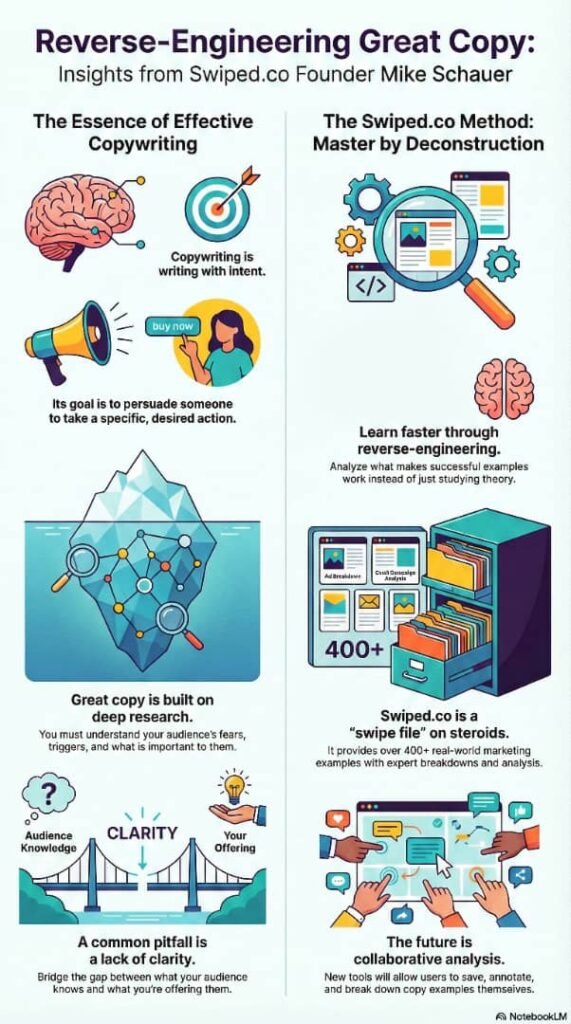
In this interview, Mike Schauer discusses his journey from being a designer to becoming a prominent figure in the copywriting industry. He explains the origins of *Swiped.co, a platform he created to archive and *reverse engineer successful marketing examples for others to study. Schauer defines copywriting as the art of using writing to prompt a specific *action, emphasizing the necessity of deep *market research over simple formulas. He also highlights his transition from a service provider to a tool creator, developing Chrome extensions that help users capture and analyze sales pages. Ultimately, the source underscores that effective communication is an essential skill for any business owner looking to improve conversions.
This website contained affiliates links.
Podcast Audio Spotify
Video Transcript
How can reverse engineering help someone learn to write copy?
Building on our discussion about blind spots, reverse engineering is a powerful way to illuminate what a writer might be missing by deconstructing successful marketing to understand the strategy behind the words. Mike Schauer, founder of swiped.co, considers this the most effective way to learn because it focuses on real-world application rather than abstract theory.
Moving Beyond Formulas and Books
While books and courses offer a foundation, Schauer argues that reverse engineering provides deeper insights by showing exactly how successful copy functions in its specific niche.
• Example-Led Learning: Instead of just memorising formulas, you look at a successful piece of copy and ask, “What are they doing here?”.
• Contextual Research: It allows you to see how others have identified what makes an audience “tick,” including their specific fears, triggers, and values.
• Component Analysis: By breaking copy down into its parts—such as hooks, power words, or power phrases—you learn how different elements work together to drive action.
Bridging the Gap and Identifying Patterns
Reverse engineering helps solve the “blind spot” of failing to make a product relatable to an audience.
• Relatability: By studying successful marketing for novel products, you can learn how to bridge the gap between a new concept and what the audience already understands (e.g., comparing a new business game to book summaries).
• Pattern Recognition: Examining a large archive of “swipes” helps you spot recurring patterns that work across different industries.
Practical Tools for Reverse Engineering
To facilitate this learning style, Schauer uses specific digital tools to “annotate” and “break down” copy.
• Annotation: This involves highlighting parts of a sales page and adding comments or “dotted boxes” to explain the intent behind specific sections.
• Workflow Integration: Using tools like Chrome extensions allows learners to save full sales pages, tag them by price point or category, and store “copy snippets” for future reference.
• Active Analysis: The goal is to move beyond just collecting examples to actively breaking them down to understand the “art of copy”